
Before coal came to dominate the story of Eastern Kentucky’s economy, another mineral drew people, commerce, roads, and industry into the mountains: salt.
Today, it is easy to overlook salt.
It sits on our tables, costs little, and can be found in nearly every grocery store in America. But in the Appalachian frontier of the late eighteenth and early nineteenth centuries, salt was anything but ordinary.
It preserved meat when there was no refrigeration. It was essential for livestock. It supported tanning and food production. It could be traded for other necessities. For families living far from established commercial centers, reliable access to salt could make the difference between a place that was difficult to inhabit and one where a community could take root.
Long before coal tipples and rail lines became familiar parts of Eastern Kentucky’s landscape, salt licks, brine wells, furnaces, kettles, pack animals, and wagon roads were already shaping an Appalachian economy.
And for a time, some of Kentucky’s mountain communities sat at the center of it.
Salt Before Coal
Natural salt licks had attracted wildlife and people long before European settlement.
Animals traveled to mineral-rich springs, creating paths that humans also followed. Native peoples knew these landscapes long before settlers entered Kentucky, and many of the routes later used by hunters, explorers, traders, and migrants followed older Native paths and animal traces.
As settlement expanded, salt became an increasingly important commodity.
Making it was laborious.
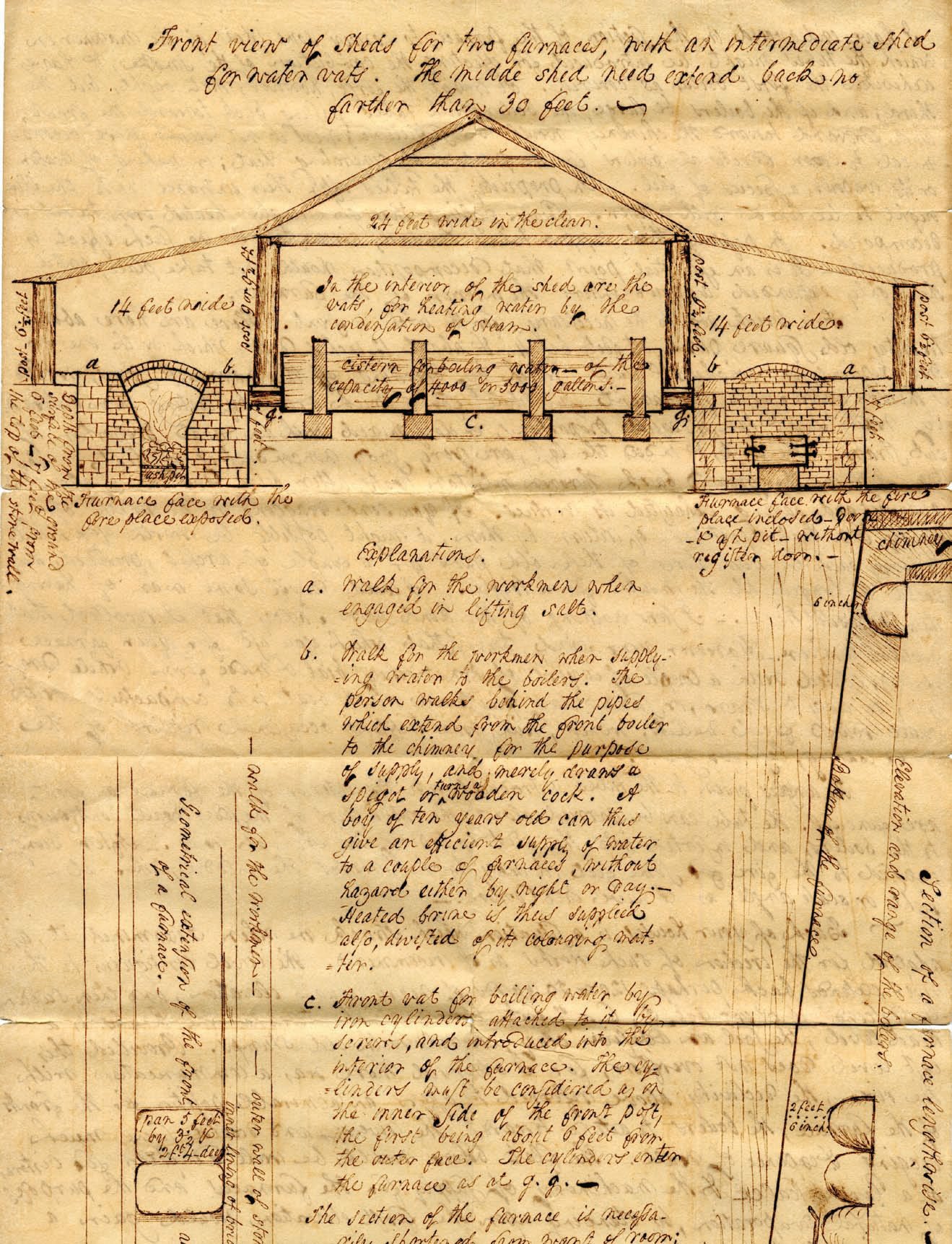
Workers drilled wells or collected brine and then boiled away enormous quantities of water until salt remained. Early operations relied on large kettles positioned over furnaces and required tremendous amounts of fuel, labor, and time.
A surviving early nineteenth-century saltworks drawing in the collections of The Filson Historical Society provides a remarkable glimpse into this process. The plan shows furnaces, a cistern for holding brine, and rows of kettles used during production.
Explore the original saltworks drawing and its history:
The Filson Historical Society: Browsing Our Archives
Salt production was not simply a household activity. Where sufficient brine could be found, it became industry.
Clay County Becomes a Salt Center
Few places illustrate that transformation better than Clay County.
After 1800, the county developed into one of Kentucky’s most important salt-producing regions. Salt works appeared along Goose Creek, Collins Fork, Red Bird Creek, and other waterways.
Producing salt required more than finding salty water.
Wells had to be drilled, sometimes largely by human or animal power. Brine had to be raised and transported. Furnaces consumed enormous quantities of wood. Heavy kettles and equipment had to reach places where roads were primitive or nonexistent.
Yet the industry grew.
Historical research preserved by The Filson Historical Society records that by 1846, fifteen Clay County furnaces were producing approximately 200,000 bushels of salt annually.
That is an extraordinary amount for an industry operating in a mountain region before modern highways, trucks, electric pumps, or industrial drilling equipment.
Read more:
The Filson Historical Society: The Salt-Making Industry of Clay County, Kentucky
The salt works also helped shape transportation.
Roads connecting the works with the Wilderness Road and surrounding markets became commercially important because salt had to move outward and supplies had to move in. Packhorses and wagons traveled into the mountains from Virginia, Tennessee, North Carolina, and elsewhere to obtain Kentucky salt.
And not every transaction involved money.
Historic accounts describe hides, furs, thread, flour, whiskey, and other commodities being exchanged for Clay County salt.
For a modern reader, that detail may say more about salt’s importance than any production statistic ever could.
Salt was woven into everyday exchange.
The Town the Salt Trade Helped Build
Manchester grew within this landscape of salt production and commerce.
The surrounding Goose Creek salt industry brought workers, merchants, travelers, animals, equipment, and trade into the area. What might otherwise appear today as a small Appalachian county seat was once connected to a regional commodity network stretching far beyond the surrounding mountains.
This was not industry in the later image we often associate with Appalachia.
There were no endless strings of coal cars or enormous preparation plants.
Instead, there were wells and furnaces, smoke rising from salt works, teams of horses and oxen, wagon roads, stacks of firewood, kettles of boiling brine, and people whose livelihoods depended upon keeping the process moving.
It was industrial Appalachia before the industrial Appalachia most Americans remember.
Perry County and the Brashears Salt Works
The salt story extended deeper into Eastern Kentucky.
In Perry County, the Brashears family developed a salt operation near what is now Cornettsville. A Kentucky historical marker records that in 1835 the Brashears well was producing salt from strong brine.
For roughly half a century, the works supplied salt to the surrounding area.
The wells were drilled by hand.
From this isolated mountain operation, salt traveled not only through Kentucky but into Virginia. Historical accounts describe it being transported over difficult mountain trails by mule and oxen.
Imagine the journey.
A commodity we now pick up without thought had to be produced by boiling brine, packed for transport, loaded onto animals or wagons, and hauled across mountain roads.
The Brashears wells survived the upheavals of the nineteenth century only to meet another Appalachian force that could not be negotiated with.
Floodwater.
According to the Kentucky Historical Society, the wells were destroyed by a flood in 1892.
Explore the historical marker:
Kentucky Historical Society: Salt Works, Perry County
Salt Goes to War
The same quality that made salt essential to mountain households made it strategically important during wartime.
Armies needed food that could survive transportation and storage. Horses and livestock required salt. Communities supporting soldiers needed preserved food.
During the Civil War, Eastern Kentucky’s salt works therefore became more than commercial enterprises.
They became military resources.
The National Park Service’s records of Civil War operations in Kentucky document the destruction of the Goose Creek Salt Works in October 1862 as Union and Confederate forces struggled for control of Eastern Kentucky.
The region was already deeply divided by the war. Control of roads, rivers, recruitment centers, supplies, and resources mattered, and salt belonged on that list.
Explore the Civil War history:
National Park Service: Civil War in Kentucky
Nearby, the Battle of Middle Creek outside Prestonsburg in January 1862 became part of that larger struggle for Eastern Kentucky. Union forces commanded by Colonel James A. Garfield confronted Confederate forces under Brigadier General Humphrey Marshall, helping secure Union control of the region during the early part of the war.
Learn more:
National Park Service: Battle of Middle Creek
Salt was not the cause of these battles.
But the destruction of salt works demonstrates how valuable the commodity remained.
An Industry Hidden Beneath Another
Eventually, Eastern Kentucky became associated with a different mineral.
Coal.
The scale of coal extraction, the arrival of railroads, the growth of company towns, the labor struggles surrounding mining, and the enormous influence of coal on twentieth-century Appalachia became so significant that they overshadowed much of what came before.
Salt slipped quietly into the background.
Yet the earlier industry had already helped shape roads, commerce, settlement, and communities.
That makes the salt boom important for another reason.
It complicates the idea that Appalachian economic history begins with coal.
It does not.
Long before coal companies arrived, mountain residents were participating in regional trade networks. Entrepreneurs invested in production. Workers drilled wells and tended furnaces. Teamsters hauled commodities over difficult roads. Families traded what they produced for what they needed.
Eastern Kentucky was remote in a geographic sense.
It was never disconnected from the larger economic world.
What Remains
Much of the physical world of Kentucky’s early salt industry has disappeared.
Wooden structures decayed. Furnaces collapsed. Roads changed. Forests reclaimed former industrial sites. Floods altered river valleys. Later development covered still more.
But absence can be deceptive.
The history remains in place names, old roads, archival records, archaeological traces, historical markers, family histories, and communities that grew around the trade.
Even the surviving drawings and accounts of the salt works give us something valuable.
They allow us to see an Appalachia that existed before the familiar photographs of coal camps and railroad towns.
An Appalachia of brine wells and boiling kettles.
Of packhorses climbing mountain roads.
Of farmers arriving with goods to barter.
Of furnaces burning through the night.
Of a mineral so ordinary to us now that it is difficult to imagine people building roads, businesses, and communities around it.
Salted Into Our Story
Coal would eventually transform Eastern Kentucky on a scale the salt makers could never have imagined.
But coal was not the beginning.
Before the mines, before the railroads, and before the company towns, people were already extracting something valuable from beneath these mountains and carrying it across Appalachian roads to distant markets.
Salt helped feed families, preserve harvests, support livestock, supply armies, encourage trade, and connect mountain communities to a much larger world.
The furnaces are mostly gone now.
The old wells have fallen silent.
But the industry left something behind.
It left roads and towns, records and family stories, and another layer in the complicated history of how people made lives in these mountains.
Sometimes the most revealing Appalachian history is not hidden because someone deliberately forgot it.
Sometimes another story simply became louder.
For Eastern Kentucky, coal became that louder story.
But before coal became king, there was salt.